
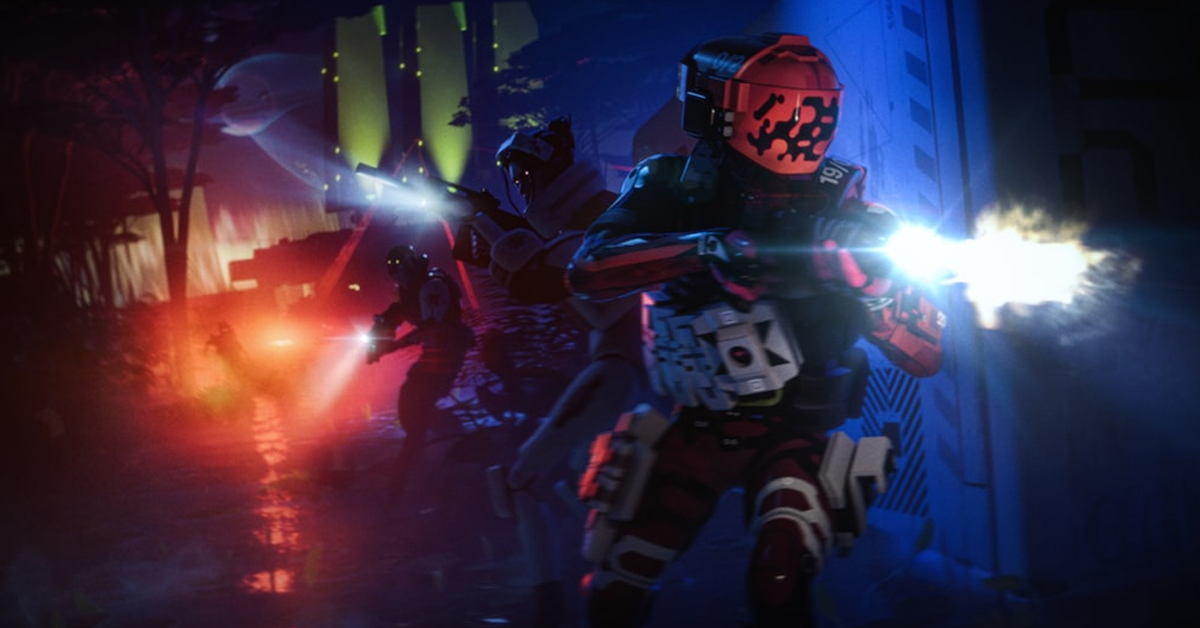
Season 2 of Marathon is called Nightfall, and the name is not just branding. Bungie are taking this game somewhere genuinely darker — darker in tone, atmosphere, and what it is willing to put in your way. The cinematic trailer dropped this week, and it is one of the more unsettling pieces of marketing for a live service game I have seen in a while. Limbs where they should not be. Shadows that move. A Runner who makes it out of Night Marsh but does not seem to come back quite right.
We are going to break down everything new in Season 2: Night Marsh, the Sentinel shell, the new weapons, and the PvE experiments. Then we will cover the broader context — the reset, the roadmap, what Bungie are trying to fix. But the new stuff comes first, because that is what Season 2 is actually selling.
Night Marsh: Marathon Goes Horror
The headline addition this season is Night Marsh — a nighttime variant of Dire Marsh, one of the game’s existing zones. On paper, that sounds like a relatively minor content addition. A reskin. A coat of dark paint on a map you already know.
It is not.
From everything Bungie have shown, Night Marsh is a fundamental reimagining of how Dire Marsh plays, built around mechanics that do not exist anywhere else in the game right now. Visibility is the starting point — this is a low-light environment where your sightlines collapse and the edges of the map become genuinely uncertain. But Bungie are not just making it dark and calling it done. They are building the zone around that darkness as a mechanic.
New equipment arrives specifically for Night Marsh: flashlights, night vision scopes, and signal flares. These are not cosmetic. They change how you navigate, how you hunt, and crucially, how you get hunted. A flashlight that helps you see also marks your position on the map for everyone else. A signal flare illuminates a contested area — useful for a firefight, catastrophic if you are trying to move quietly. These are design decisions that force tradeoffs of the kind that make an extraction shooter feel meaningful, and they are built specifically around this zone.
The UESC presence is escalating significantly. New Warden encounters, new enemy types, and, according to the official Season 2 notes, a specific new threat designed to shut down Runner activity entirely — something that is not just a harder version of an existing enemy, but a new kind of obstacle. Bungie have not named it yet. The trailer teases it through glimpses and wrong geometries rather than a direct reveal.
There is a sequence in the cinematic where a downed Runner’s flashback shows them being cornered by something that moves unlike the enemies in Season 1. It is brief, but it is deliberate. Bungie know what they are doing with that shot.
The horror direction here is not accidental, and it is not purely aesthetic. Extraction shooters live or die on tension, and tension requires uncertainty. Night Marsh is designed to restore a version of that uncertainty that the current maps, which experienced players have largely mapped and predicted, no longer provide as reliably. You know Dire Marsh. You do not yet know what is in the dark version.
Sentinel: The Defensive Shell
Every season adds a new Runner shell, and Season 2’s is Sentinel. Where most of the existing roster is built around aggression or mobility, Sentinel is explicitly defensive — designed for holding ground, protecting teammates, and punishing the kind of rush tactics that have defined high-level play throughout Season 1.
The kit breaks down into three abilities.
The first is the Defender System — an automated laser platform that shoots down incoming grenades and missiles while simultaneously improving weapon handling for nearby crew members. If you have played any amount of Cryo Archive and spent time being deleted by grenade spam, you already understand why this exists. It directly counters one of the most complained-about elements of Season 1’s endgame meta.
The second is the Snare Mine — a proximity mine that ensnares rushing enemies. Not a kill tool. A positioning tool. It is designed to slow down the squads that close distance aggressively, giving your crew time to react instead of being overwhelmed before you can establish a line.
The third is Prey Tracker — a short-range motion tracker that reveals nearby moving targets. This is the offensive element of an otherwise reactive kit. You are not hunting across the map. You are identifying what is about to come through the door.
Taken together, Sentinel feels like a direct response to a specific pattern in Season 1 play: aggressive squads closing distance fast, popping abilities on entry, and overwhelming teams before positions could be established. Sentinel is the answer to that. Whether that makes it overpowered in the right hands or situationally useful without becoming dominant is something the first few weeks of the season will determine.
The design direction is interesting beyond the numbers, though. All of Sentinel’s upgrades are shared across shells and can be reconfigured at any time with no penalty — that is the Cradle system, which we will get to — and that means Sentinel’s tools are available to any playstyle willing to engage with the new progression architecture. The shell defines a role. It does not lock you into one forever.
In the cinematic, Sentinel’s shell design reads as heavier and more grounded than what we have seen from other Runners. There is something almost medieval about the silhouette — plated, deliberate, built to absorb. It fits the horror atmosphere of Night Marsh in a way that feels intentional. This is not a speedrunner. This is something that stands its ground.
New Weapons: KKV-9SD and D54 Battle Pistol
Two new weapons are confirmed for Season 2: the KKV-9SD SMG and the D54 Battle Pistol.
The SMG is the one the trailer lingers on. The design is notably more analogue than Marathon’s usual aesthetic — with traditional iron sights and a rawer silhouette. For a game that has leaned into clean sci-fi lines, the KKV-9SD looks like it came from an older era, or from someone who needed a weapon and had to make do. Whether that is lore-intentional or just a design choice, it stands out. Performance-wise, both weapons are being positioned as close-range tools — effective against Runners and UESC units alike, which suggests neither is a pure PvP or pure PvE pick.
The D54 Battle Pistol slots into a secondary role that Marathon has not had a great answer for in close quarters. A battle pistol — heavier than a sidearm, lighter than a primary — fills a gap in the weapon roster that solo players and aggressive duos will recognise immediately.
New mods and contracts are attached to both, which means the loot chase in Season 2 has specific anchors from day one. If you are running Night Marsh, looking for a reason to stay in the zone longer than necessary, these are it.
Sponsored Survival: The PvP Lite Experiment
Everything above is the content of Season 2. This is the philosophy of it.
Alongside Night Marsh, Sentinel, and the new weapons, Bungie are launching a new experimental mode from June 2nd to June 9th called Sponsored Survival. It runs concurrent with Open Play Week, which is not a coincidence. This is the mode designed to convert people who bounced off Marathon in Season 1.
Here is how it works. A single crew drops into Night Marsh — alone. No other players on the map. For the first few minutes it is just you, the UESC, and whatever is lurking in the shadows. You can explore, loot, and move without the constant threat of a fully-kitted squad materialising out of the dark. Then, after that initial window, backfilled Rooks begin entering the map.
Those Rooks are not automatically your enemies. They could stay solo, team up with each other, or approach your crew. Bungie’s language on this is deliberate — everyone’s goal is survival, and how you get there is up to you. The social dynamic is preserved. The immediate all-bets-are-off tension of a standard run is not.
The only exit is the final exfil, which spawns when the eighteen-minute run timer hits zero. Everyone on the map has a limited window to reach it. And then comes the decision that makes this mode interesting: do you negotiate a truce and leave together, or do you turn your weapons on each other in the dead of night?
That structure is smart. Bungie are not removing the PvP threat — they are delaying it and concentrating it. The paranoia of a standard run is spread across every moment from the moment you drop. In Sponsored Survival, it collapses into a single point at the end. The question of whether to trust the stranger at the exfil is, if anything, more charged than any mid-run engagement, because you have had eighteen minutes to watch each other, figure out each other’s playstyle, and decide whether a deal is worth making.
There are structural guardrails keeping the stakes low. Crews must bring a Sponsored Kit loadout — basic gear, no hoarded endgame equipment. This protects the Rooks entering later from being immediately deleted by a crew that has been looting for ten minutes, and it signals to everyone on the map that the ceiling on power is capped. You are not going to run into the sweatiest squad in the game here. The format enforces a degree of parity.
Solo and duo play is supported on the crew side — you can disable queue fill and run with one teammate or alone. All other Rook queues are disabled while the mode is active, which means if you are queueing as a Rook during Open Play Week, this is where you end up.
Bungie are also confirming a full PvE-only mode arriving in the latter half of Season 2 — no PvP at all, objectives-focused, completely separate from Sponsored Survival. Beyond that, they mention a more purely PvP-focused experiment as a possible future addition. The experimental queue framework they have been building since Duos and Sponsored Queue in Season 1 is now clearly functioning as a testing ground for fundamentally different ways to play the game, not just minor format variations.
The honest question Sponsored Survival is answering is whether the tension in Marathon can be modulated rather than simply turned on or off. Standard runs are maximally stressful. A full PvE mode removes player threat entirely. Sponsored Survival sits in between — a run with breathing room at the start, genuine social ambiguity in the middle, and a moment of genuine stakes at the end. It is a more sophisticated design than “here is an easier version.” Whether it feels like Marathon or like something adjacent to it is something the first week of the season will tell us.
The Reset, The Roadmap, and the Bigger Picture
Before we close out, here are the things you need to know about the seasonal structure.
Season 2 brings Marathon’s first full reset. Runner Level, Ranked Level, Faction Levels, currencies, inventory, vault items, and schema unlocks all go to zero. Everyone starts on equal footing. What you keep: cosmetics, titles, emblems, Codex challenge progress, faction unlocks, LUX and SILK balances, and Rewards Pass progress. The things with meaning beyond a single season are preserved.
If you have time before the reset, check your Runner Level against the Season 2 Sponsored Kit thresholds — Enhanced kits at Level 10 and 25, Deluxe at 50, and Superior at 75. These carry into Season 2, and they are worth pushing for if you are close.
On the roadmap: Bungie published a multi-season plan out to Season 5. Season 3 is where the onboarding overhaul is scheduled — major revisions to the new player experience and big updates to Perimeter. Season 4 deepens the extraction loop. Season 5 is where PvE, PvP, and hybrid modes are supposed to come together into something more cohesive.
The Season 3 note matters. Onboarding — which Bungie itself identified as one of the four core failures of Season 1 — is not being fixed in Season 2. That fix is one season away. Whether the players who bounced at launch will give it another look before then is the open question that Open Play Week is partly trying to answer.
Verdict
Night Marsh looks like the best thing Bungie have built for Marathon so far. The horror direction is committed, the new mechanics have genuine depth, and the cinematic suggests a lore layer that the game’s first season only gestured at. Sentinel fills a real gap in the Runner roster. The new weapons have distinct identities. The PvE experiments are a genuine bet on an audience that has not fully arrived yet.
This season is stronger than Season 1 across every content axis that matters. Whether it is enough to hold and grow the player base it needs is a different question — and that answer is coming fast. Season 2 launches June 2nd.
I will be in Night Marsh from day one. The Sentinel breakdown and the first look at the PvE mode will be here when they are live.